Photo by Vince Fedoroff
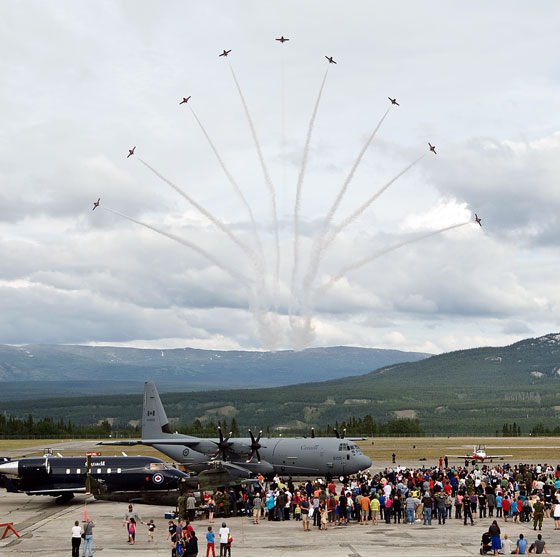
FLYING FORMATION 鈥� The Canadian Snowbirds perform Wednesday evening at the Erik Nielsen Whitehorse International Airport. Along with the Snowbirds, a variety of military aircraft presented an air show and static display.
Photo by Vince Fedoroff
FLYING FORMATION 鈥� The Canadian Snowbirds perform Wednesday evening at the Erik Nielsen Whitehorse International Airport. Along with the Snowbirds, a variety of military aircraft presented an air show and static display.
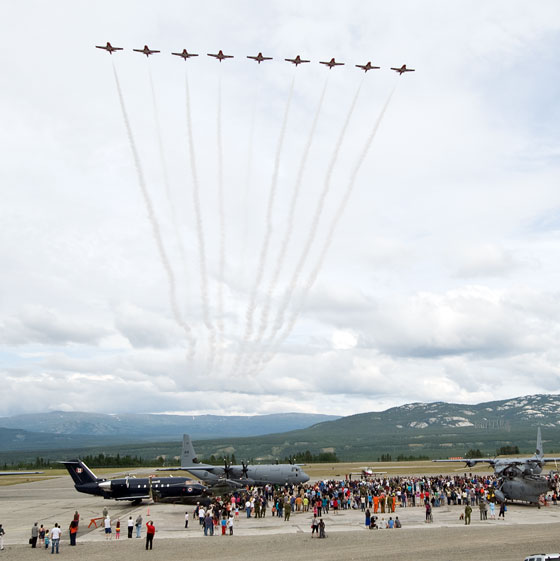
Photo by Vince Fedoroff
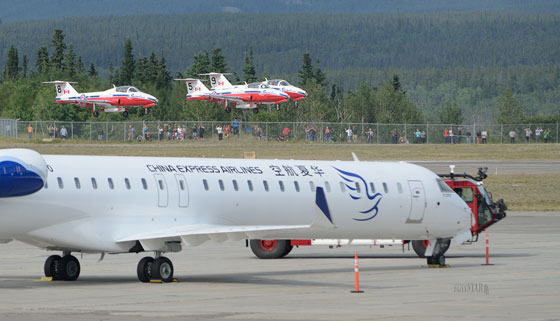
Photo by Vince Fedoroff
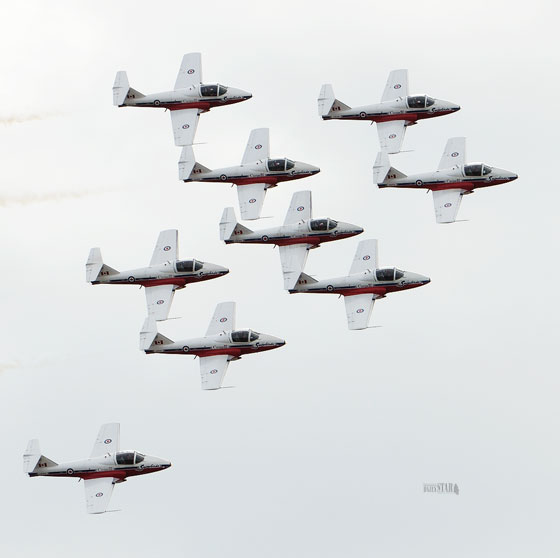
Photo by Vince Fedoroff
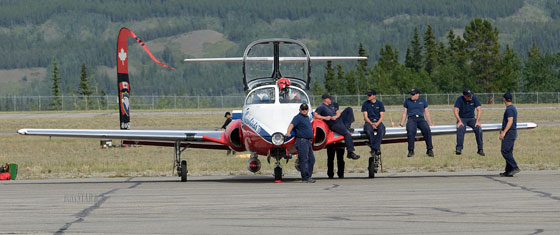
Photo by Vince Fedoroff
Synonymous with national pride, the Snowbirds are a Canadian icon.
Synonymous with national pride, the Snowbirds are a Canadian icon.
The team travels across North America each summer, thrilling spectators with their aerial acrobatics.
Nine red and white CT-114 Jets cut through the sky, reaching speeds that top 550-kilometre's an hour while flying within four feet of each other.
Inside the cockpit are nine highly trained, precision athletes with years of experience preparing them for each flight.
Officially known as the Royal Canadian Air Force's 431 Air Demonstration Squadron, the Snowbirds took to the Whitehorse sky on Wednesday night.
It was their fourth appearance in the last five days, with the last air show taking place in Watson Lake this past Saturday.
Hundreds of people lined the tarmac at the Erik Neilson International Airport, with even more scattered along the chain-link fence, clay cliffs, and Alaska highway.
They watched with piqued interest as the planes dove from the clouds and shot back into the sky.
The pilots, strapped into an ejection seat inside the sweltering cabin, battle the negative and positive g-force that accompanies the steep descents and powerful accelerations.
Too much negative force and the pilots can quickly lose consciousness as the blood rushes to their head.
As the positive force rises, the tension on the control stick grows heavy.
Suddenly, a one pound weight feels like five pounds.
A loop maneuver makes a 200-pound pilot feel as though he weighs a thousand pounds.
To combat the stress on their bodies and the blood rushing to their heads, the pilots are constantly contracting their abdominal and leg muscles, attempting to keep the blood in their torso.
"The guys work out everyday,鈥� said the Snowbirds public affairs officer, Cpt. Thomas Edelson.
"They're runners, good hockey players, they lift a lot of weights and some practice martial arts.鈥�
Each pilot must maintain a weight below 209 pounds, anything more than that and the ejection seat can't function properly.
When they begin their show season in mid-May, they are on the road for the next six months where barbecue's and hangar parties are plentiful and the time needed to prepare proper meals is lacking.
"Life on the road is a challenge,鈥� said Edelson. "It can be easy to put on weight.鈥�
The pilot's also have to combat the emotional stress that accompanies being separated from their families for months at time.
Between now and end the year, Edelson suspects the 24-person crew that makes each show possible will get about seven days at home.
"You miss your families; you miss your wife and your kids or your fianc茅s. You miss your dog or your cat, you miss everything,鈥� said Edelson.
"It is hard. You come home from the road and there's a lot of upkeep to do and you want to spend time with your family but you've got mow the lawn, get the mail, pay your bills, have a barbecue and get back to the squadron and re-pack.鈥�
Behind the scenes there are dedicated technicians, engineers and command officers that make everything possible.
"It really is a team, it's a total team effort,鈥� said Edelson.
"The pilots fly the planes but all the technicians that service the planes make it possible. They work incredibly longs hours, they work in the rain, and they work in the sun. I've come back in the morning and seen lights set up so they can work through the night.
"They are incredibly skilled. Without the technicians, no one is getting off the ground.
"It's s a really unique and amazing job but it is also exhausting. We literally work seven days a week.鈥�
Each year, eight candidates are selected to try-out to be part of the team.
To apply to become a Snowbird pilot, you generally need more than 10 years of experience.
"You need your military wings, which can take between five and seven years to obtain and you need 1,300 hours of flying experience in an ejection seat, which can be another five years depending on how much you fly,鈥� said Edelson.
That's just to apply.
If you're one of the candidates selected to move forward with the program, you're taken to the Canadian Forces Base in Moose Jaw, Sask., where you fly twice a day for three weeks.
"We fly them pretty heavily for those three weeks,鈥� said Edelson.
"You've got to have good nerves, you've got have really good hand-eye coordination.
"There's no electronic sensors, it's all visual. It's hands and feet that allow the tight formations so you need to have really strong nerves. You need to have the aptitude to learn all the dynamics.鈥�
In the end, four pilots are selected and added to the team.
The tour of duty for the pilots is normally limited to three years.
The Snowbirds average more than 70 air shows in 50 locations across North America each summer.
"It's an amazing way to see Canada and travel to places that a lot of people don't get to see,鈥� said Edelson.
"The Yukon, in my opinion is one of the most beautiful areas I've flown over.
"The Mackenzie Delta is amazing. I've seen the Amazon before and the Mackenzie seems to me just as big.鈥�
After the Snowbirds performed their fly-over at the gold medal game of the ISF Women's World Fastball Championships this past Sunday, they continued their journey about 200 miles west, where they flew over the Lowell Glacier.
An experience, that Edelson said was one of the best he's had with the Snowbirds.
"That was beautiful scenery,鈥� he said.
"A lot of the guys were saying that was one of the best flights of their life to fly over this amazing glacier.鈥�
The Snowbirds were also joined by the CC-177 Globemaster III and CC-130J Hercules transport aircraft; the CP-140 Aurora long-range patrol aircraft; the CC-115 Buffalo search and rescue aircraft; the CC-138 Twin Otter utility transport aircraft; the CH-146 Griffon, CH-124 Sea King and CH-149 Cormorant helicopters; and two CF-18 Hornet fighter jets.
"We love this. It's fun to show what we can do,鈥� said Shannon Brown minutes before taking off in her Griffon helicopter for an aerodynamic display.
"It's been awesome, the people in the North have been really good to us.
"They are always welcoming and always interested. It's been a really good experience for everyone.鈥�
In order to encourage thoughtful and responsible discussion, website comments will not be visible until a moderator approves them. Please add comments judiciously and refrain from maligning any individual or institution. Read about our user comment and privacy policies.
Your name and email address are required before your comment is posted. Otherwise, your comment will not be posted.
Be the first to comment