Photo by Photo Submitted
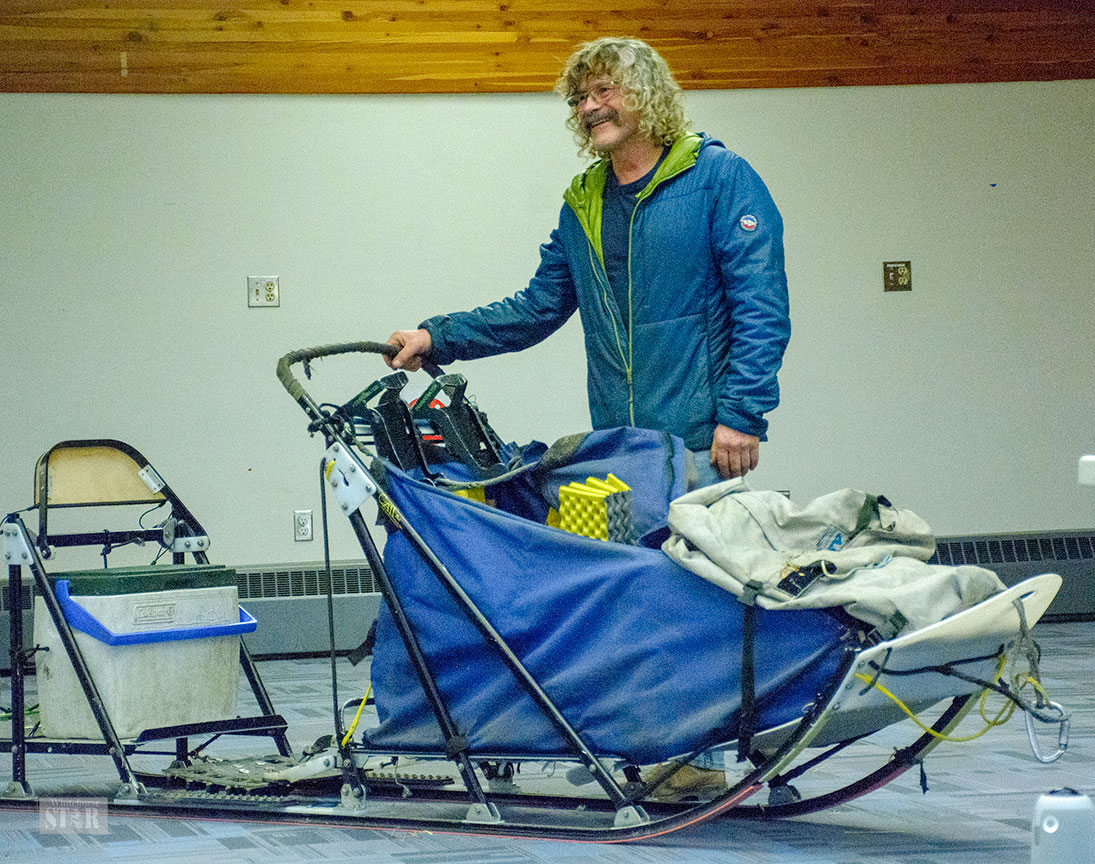
SUPER SLED – Veteran Yukon Quest musher Ed Hopkins shows off his sled at the Yukon Quest Rookie Workshop at Mount McIntyre Saturday.
Photo by Photo Submitted
SUPER SLED – Veteran Yukon Quest musher Ed Hopkins shows off his sled at the Yukon Quest Rookie Workshop at Mount McIntyre Saturday.
A trio of presenters shared their wisdom with Yukon Quest mushers and the public Saturday at a rookie workshop at the Mt. Mac Recreation Centre.
A trio of presenters shared their wisdom with Yukon Quest mushers and the public Saturday at a rookie workshop at the Mt. Mac Recreation Centre.
The event featured Dr. Kate Foster, the head veterinarian for the 2023 Yukon Quest, Ed Hopkins, a veteran Quest musher and current board member and Christiane Koch-Champeval, a certified canine massage practitioner with a specialty in sports massage.
The Star was there for some of Hopkin’s presentation.
When asked about tents, Hopkins responded “A tent, for me, is something else I don’t need in my sled … it’s taking up too much space, I’m spending too much time putting it up and down. That’s all time that can be used for something else.”
Legendary Quest musher Frank Turner mentioned using a tarp to cover yourself on the trail.
Turner said “If you’re by your sled and you’ve got a dog moving in the line, if something’s going on, you feel that right now.
“If you get yourself out of the game and you go into a tent, where you don’t have the visual … you’re losing the connection.”
Turner later told a story about racing in one Quest with Hopkins in which Hopkins had only seven dogs and used a telescopic pole to his advantage to keep up with Turner.
“Every time I looked back, he was there. And I knew I was moving pretty good. And I thought ‘What the hell is going on here?’ Then it was after the race later on, he told me, he said ‘Frank, it took me til August until my arm was healed up from the pumping’ … I couldn’t believe he stuck with me. We were in a lot of hills there, and he just poled and poled and poled.”
Hopkins was asked about how he stays awake on the trail.
“I take six or seven pieces of the most spiciest gum I can find and I chew that. It keeps me awake. You feel like your breath is on fire, you’e shooting flames out of your mouth … whatever it takes.”
Hopkins talked about how everything on the sled has to be lined up perfectly, including the harnesses and lines, in order for the sled to steer straight.
“Try to do that for six or seven or eight hours a day for 10 days in a row. You’re not just sitting there, as some people think you are. You’re steering that sled. You’re paying attention to the trail. You’re trying to find the straightest part of that trail as you can. You want your sled to be steering straight. That’s little things, that’ll take seconds off your run, or hours after a day, or half a day over a thousand miles.”
He also talked about how he takes care of his dogs on the trail, including massaging them and tending to their tired paws.
Hopkins was also asked about his checkpoint routine, including getting in and out of checkpoints and gave a detailed description of how he deals with that, including feeding and watering the dogs.
Hopkins also mentioned that he carries an extra bag of dog food on top of his sled in case he runs into another musher in trouble.
“There’s many times you come down the trail and somebody’s out there having issues. They need some food, been there for a few hours, you’ve got something you can give to them … you’re trying to compete with them, but you don’t want to see them suffer either.”
Hopkins was asked how to deal with the attention that mushers and their dogs receive on the Quest, especially at the start line.
“It’s up to you. You have to be calm and the dogs feed off of you. If they look at you and you’re like, ‘It’s not a big deal,’ then they’re like, ‘I guess it’s not a big deal’.”
He talked about how to get his young dogs used to being on the trail as well.
“The amount of time you spend in the dog yard and on the trail with your team is paramount. You get to know them in the yard, their personalties, but when you’re training, go camping with them. Spend as much time camping with them as possible. Get your camping routine down … your dogs get used to your routine.
“For new dogs, they’re gonna go ballistic … they’re gonna be barking and screaming and carrying on. So what I do is I have a little cable gang line … for dogs like that I’ll just pull it out and I’ll put the yahoos on there so these guys here (the older dogs) can sleep and these guys here (the young yahoos) can figure it out. They can watch and see what everybody else is doing.
“So camping is a great thing to do. Run five hours, rest five hours; they figure it out eventually.”
Hopkins, of course, also lent the novice mushers his wisdom regarding training routines for his animals.
“Dog mushing isn’t a negative thing; it’s all positive reinforcement training. That’s what you want.”
The Star spoke with Hopkins after his presentation. He thought it went well.
“Nice little turnout here, get some rookie people here … wet their whistle, give ‘em these ideas of what they can go and train with.”
Hopkins had some important tips for the fledgling mushers.
“It’s just basically about packing your sled. I kind of touched on checkpoint routines and musher hydration and how to keep yourself in shape so you don’t make bad decisions.”
Hopkins was asked what obvious items mushers are most likely to forget to take with them on the trail.
“Usually the thing that they would forget would probably be their food dishes and their dipper … there’s so many things. You can’t pick just one … there’s so many moving parts when you’re running dogs.”
Quest operations manager John Hopkins-Hill said “I think today’s workshop was really successful. The presenters were fantastic. The attendees were interested in learning what the presenters had to share. There were a lot of really good questions. There was some good discussion. All the participants that I’ve spoken to have left here feeling like they’ve learned something, which is all you can really ask for.
“We’re hopeful that this puts the mushers that took part with us today – and the ones that aren’t registered for the Quest but wanted to come to this workshop … in a situation where they feel like they’re now better equipped to race.”
Hopkins-Hill added “We had approximately 20 mushers sign up and of those 20, I believe that basically half were Quest mushers. There was three or four people from Quebec who joined us, who aren’t registered to mush, as well as a couple of Quebec mushers. But we also had some folks from Alaska and from Wisconsin who wanted to sit in on the workshop, so what that really tells me is that … there is an appetite for this kind of programming. People do still want to learn. They do still want to get better and whatever we can do to help – and I think this workshop was successful in helping.”
In order to encourage thoughtful and responsible discussion, website comments will not be visible until a moderator approves them. Please add comments judiciously and refrain from maligning any individual or institution. Read about our user comment and privacy policies.
Your name and email address are required before your comment is posted. Otherwise, your comment will not be posted.
Be the first to comment