Photo by MARCEL VANDER WIER
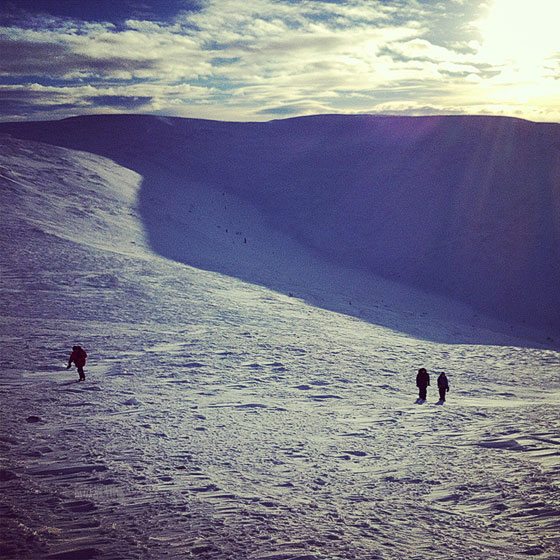
WHERE THE MAGIC HAPPENS 鈥� A group of news photographers witnessed the true spirit of the Quest trail after hiking up Eagle Summit.
Photo by MARCEL VANDER WIER
WHERE THE MAGIC HAPPENS 鈥� A group of news photographers witnessed the true spirit of the Quest trail after hiking up Eagle Summit.
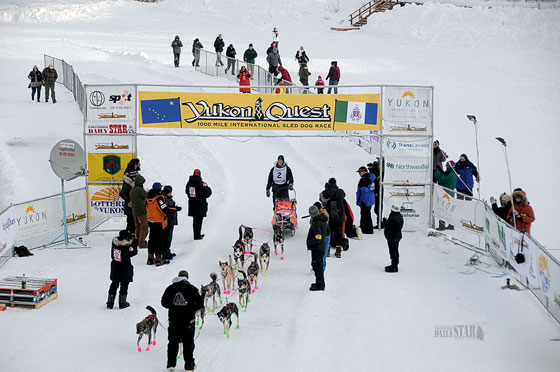
Photo by MARCEL VANDER WIER
THE END OF THE ROAD 鈥� Norwegian rookie Markus Ingebretsen crosses the Yukon Quest finish line in Fairbanks last Tuesday. The 21-year-old placed sixth in the race.
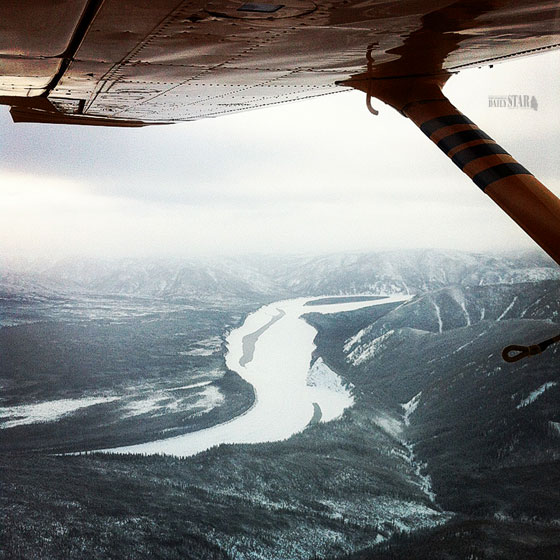
Photo by MARCEL VANDER WIER
SPECTACULAR VIEW 鈥� The Yukon River outside Dawson City, as viewed from a Cessna 206.
Like all great experiences, this one's going to take a while to sink in.
Like all great experiences, this one's going to take a while to sink in.
Spending a frenetic two weeks on the Yukon Quest trail was exhilarating and exhausting, magical and mentally-draining 鈥� all at the same time.
I had prepared as much as one possibly could for this adventure. For the better part of a month, my newsroom colleagues and I had worked long hours catching up with mushers and race officials to put together a special 24-page newspaper pullout on the 30th anniversary of the toughest sled dog race in the world.
Reporters who had previously covered the Quest were grilled with questions on checkpoint living and sled dog etiquette, but no amount of explanation can truly prepare one for life on the trail.
On Feb. 2, I was one of the thousands of people who came out to watch the start of the race in Shipyards Park. Chills ran up and down my spine as dreamer Rob Cooke pumped the air with his fist, and past champions Hugh Neff and Lance Mackey burst out of the chute to cheers and applause.
That night, Star photographer Vince Fedoroff and I picked up Fairbanks Daily 麻豆社区-Miner reporter Jeff Richardson from his Whitehorse hotel and made for Braeburn 鈥� the first of eight checkpoints along the race route.
Because the Quest trail follows major road systems for most of the journey, reporters and team handlers are able to keep pace with mushers traveling on the historic gold rush trail 鈥� the Yukon River.
We arrived at the Braeburn Lodge hours before the first sled dog team. The small lodge was full to capacity with trail officials, race volunteers, and members of the media or public relations team.
This is where I learned what Quest reporting was really like.
The job isn't all about glamour and adventure. In fact, much of our time was spent waiting outside at checkpoints for any sign of a sled dog team.
However, the sight of a musher's headlamp piercing the darkness, followed by a team of dogs sliding into view in a cloud of their own breath never failed to provide a fresh jolt of adrenaline, no matter the hour.
As dog teams arrived, my two Alaskan media colleagues and I were given the opportunity to ask mushers questions about their journey, before they headed back out on the trail or inside for a bite to eat.
Interviews complete, we returned inside, pulled out our laptop computers and began recording the first stories of the race.
And so began the cycle of life on the Quest trail.
From Braeburn, we headed to Carmacks, then Pelly Crossing. At each checkpoint, we would conduct interviews, write stories, and then try to find a flat piece of ground to pull out a sleeping bag and get a few hours sleep.
SPOT trackers attached to each musher's sled helped us plan our sleep schedules, but when a tracker malfunctioned and failed to update team locations, agreements were formed between friends to wake each other when the next musher arrived.
The 40-hour layover in Dawson City was reinvigorating for all involved in 鈥� as one of my colleagues put it 鈥� the traveling circus.
In Dawson, we boarded a Cessna 206 and flew across the Canada-U.S. border into Eagle, Alaska, a small trading post community established in the 1800s to supply miners working in the North.
Seeing remote Alaska from the air was an experience all on its own. Mountains and valleys appeared like a pencil sketch of blacks, whites and greys, broken only by the wide swath of the Yukon River.
The visit to Eagle was also memorable, but that experience could fill a page on its own.
After spending a couple of days in the historic town, population 87, we boarded another small plane bound for Circle, where we were met by 麻豆社区-Miner photographer Sam Harrel.
This was the point where we started chasing the race leaders 鈥� Neff and Allen Moore. We rushed through the checkpoints of Central and Two Rivers, simply trying to keep pace as the two mushers began pulling away.
We did manage to scrape together enough time to hike Eagle Summit, and our efforts were rewarded in full.
While perched on the windy slope, we witnessed the true spirit of this race when Brent Sass passed Jake Berkowitz, before parking his team and, in a moment of true sportsmanship, returning to pull his competitor's sled dog team up the hill by hand.
Racing Moore to the finish line in Fairbanks was another moment I'll never forget.
On the way to the checkpoint on the frozen Chena River, Richardson and I found ourselves stuck waiting for a stopped train and were further slowed by two snowplow operators clearing the streets early Monday morning.
We eventually made it, with time to spare, and were able to document another historic win for the Yukon Quest.
Looking forward to doing it all again in 2014.
In order to encourage thoughtful and responsible discussion, website comments will not be visible until a moderator approves them. Please add comments judiciously and refrain from maligning any individual or institution. Read about our user comment and privacy policies.
Your name and email address are required before your comment is posted. Otherwise, your comment will not be posted.
Be the first to comment