Recently-blinded player vows to continue career
The night before the Mac's Midget AAA hockey tournament, Kole Comin woke up with his left eye swollen shut.
By Marcel Vander Wier on March 7, 2014
The night before the Mac's Midget AAA hockey tournament, Kole Comin woke up with his left eye swollen shut.
The 16-year-old forward from Whitehorse would never get an opportunity to play in the prestigious event, and instead was diagnosed with acute retina necrosis in a Calgary hospital.
Upon his return to Prince George, Comin lost all vision in his left eye. He was flown to Vancouver, where he spent a week in hospital with hopes of having some of his vision restored, to no avail.
"We weren't expecting it to get to this,鈥� Comin admitted.
The tragic turn of events hasn't kept Comin off the ice, however.
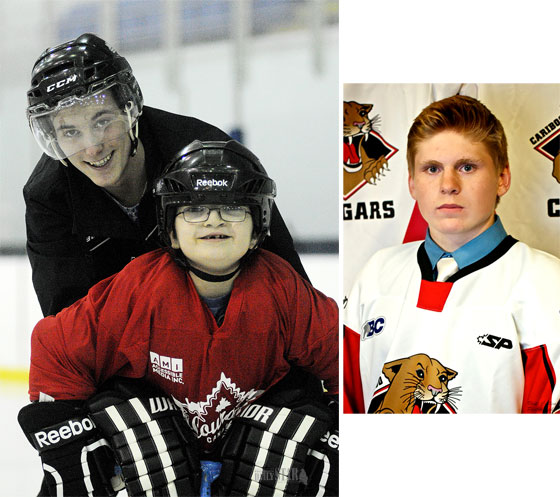
He has returned home to the Yukon capital where he began playing with the rec league Air North Jets. He is also a member of the territory's Arctic Winter Games hockey roster.
The loss of vision has changed the way Comin plays the game he loves.
"I just have to be more aware, looking around more, always moving,鈥� he said. "I鈥坱hink I've grown accustomed to it. I've been on the ice every day, trying to get used to it. I'm going to try and make the best of it, and see what happens.鈥�
Comin vowed to be in the Cariboo Cougars mix of forwards again next season. In 26 games this year, he finished with two goals and 31 PIM.
"It was probably the best feeling I've had yet,鈥� Comin said of his time in Prince George. "It was everything I鈥坰et out for.鈥�
Earlier this week, Comin could be found back on his home ice with some of his former Whitehorse Mustangs teammates, helping visually-impaired youngsters learn the Canadian game.
Thanks to Courage Canada, a group of Whitehorse youth got an opportunity to strap on the skates and learn how to play hockey.
Mark DeMontis, founder and president of Courage Canada, led the youngsters onto the ice at the Canada Games Centre Tuesday afternoon.
On the ice, each vision-impaired player was paired up with a skating mentor for assistance. It marked the first time Courage Canada has ever held a program in the territory.
"The genesis of this organization is to provide these youth with something that they don't really get the chance to do,鈥濃�圖eMontis told the Star. "This is Canada. Skating and hockey are something that mean a lot to all Canadians. No matter what province or territory you're in, you should get the chance to do it, even despite your situation.鈥�
DeMontis, 26, knows first-hand what a vision loss feels like.
When he was just 17 and playing AAA hockey in Toronto, DeMontis's hope of an NCAA scholarship vanished when he was diagnosed with Leber's Optic Neuropathy 鈥� resulting in the slow loss of the central vision from both his eyes over the following six months.
DeMontis was left with just his peripheral vision, which allows him to see shapes and shadows.
"I stopped playing traditional hockey because of the diagnosis and I started playing blind hockey 鈥� and that's what gave me the opportunity to keep playing the game I love,鈥� he said.
The experience led DeMontis to found Courage Canada in hopes of bringing the blind hockey program to youngsters across the country.
Ruth Ferguson is a teaching specialist for visually impaired students at Yukon Education Student Support Services.
She said nine school-aged children and four others from the Helping Hands program took advantage of the program.
"For the majority of these kids, this is their first time on the ice,鈥濃�圖eMontis said. "Not one of these kids knew what blind hockey was, and that's what is so important about our coming here. These kids realize that just because they have a visual impairment, doesn't mean they can't play our nation's game.鈥�
Blind hockey sees players use an oversized puck that makes noise while moving. Partially-blind players will play forward while fully-blind athletes typically play defence and goalie.
DeMontis said experiencing hockey helps players gain confidence, independence and self-esteem.
Be the first to comment