Photo by Vince Fedoroff
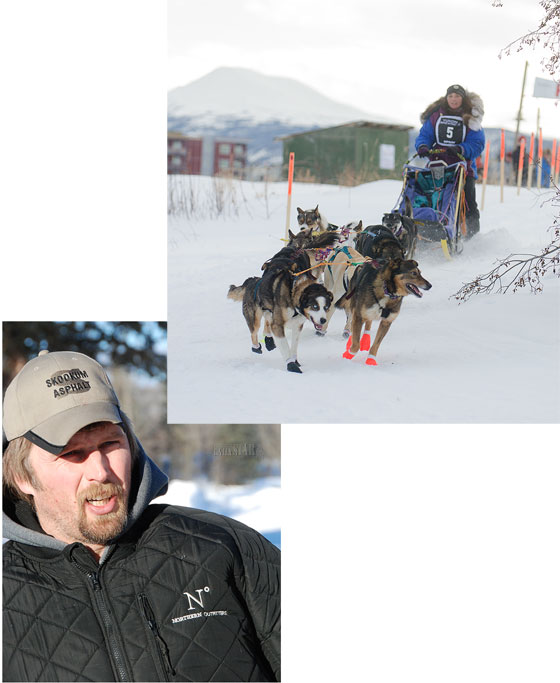
LOOKING TO CHALLENGE – Tagish musher Michelle Phillips, pictured competing in last weekend's River Runner 120, is one of two Yukoners racing in the 2013 Iditarod. Jerry Willomitzer
Photo by Vince Fedoroff
LOOKING TO CHALLENGE – Tagish musher Michelle Phillips, pictured competing in last weekend's River Runner 120, is one of two Yukoners racing in the 2013 Iditarod. Jerry Willomitzer
Two Yukon mushers will be pushing for top finishes in the "last great race on earth.�
Two Yukon mushers will be pushing for top finishes in the "last great race on earth.�
The 1,609-kilometre (1,000-mile) Iditarod, which will see 66 teams trek behind their sled dogs across Alaska from Anchorage to Nome, begins tomorrow.
Michelle Phillips and Gerry Willomitzer will represent the Yukon in the race.
Alberta's Aaron Peck rounds out the Canadian contingent in the 2013 edition of the Iditarod – the 41st running of the famous Alaskan sled dog race.
Phillips will be the sixth musher to leave the chute tomorrow, while Willomitzer will begin in position 20.
Both Phillips and Willomitzer are Iditarod veterans, with Phillips competing the last three years, and Willomitzer the last six.
Phillips' top finish came last year when she finish 16th, and the Tagish musher said she will be looking to beat that mark this time around.
"I'm excited,� Phillips said yesterday. "We've worked really hard all season for this moment.
"My goal is top 10 for sure. That's what I'm driving for.�
Phillips' sled dog team is a combination of dogs from both her winning YQ300 team and her husband Ed Hopkins' Yukon Quest team.
Hopkins finished last month's Quest in 11th place, running with many of Phillips' less-experienced dogs.
In last weekend's River Runner 120, Phillips split the 20 dogs she chose from between herself and her handler Marie Royer for one final training run.
"I have a nice team,� said the 44-year-old Phillips. "I've created the best team I thought I can make. They're well-trained and they're a group which I've raised myself from puppies, so we're a real tight group.�
Phillips said there's really no substitute for a race like the Iditarod. While she enjoys the Yukon Quest, the prize money is no comparison.
"The purse is a lot better, and that is a really challenging thing in the Quest,� Phillips said. "They just have no purse, and it's really hard as a professional musher … We spend a lot of money in training and trying to survive.�
The Iditarod's purse currently stands at $600,000, as compared to the Quest at $100,000.
"Basically, in the Iditarod, you get a lot more exposure, and you're going up against the best,� she added. "It's the biggest dog race in the world, and it's a pretty big thing to be competing against a lot of the world's best mushers. You really find out where you're at.�
Phillips said she is proud to represent the Yukon in the Iditarod.
"It means a lot to me,� she said. "I'm proud of being a born-and-bred Yukoner.�
Willomitzer echoed those sentiments. The 43-year-old Whitehorse musher runs the Iditarod with a Canadian flag draped over his sled.
Born and raised in Germany, Willomitzer gained his Canadian citizenship three years ago.
"I definitely consider myself a Yukoner, having lived there since the mid-90s,� he told the Star. "I'm not shy to show the flag.�
Willomitzer's top Iditarod finish came in 2010, when he placed 13th. He has battled bad luck recently however, scratching from the race each of the past two years.
This year, things are once again looking up.
"It's the perfect team, really, minus the experience of finishing in Nome,� Willomitzer said of his prized sled dogs. "I definitely see myself in the top 30 … the goal has always been going into the top 10. That's been the elusive goal for the last few years.�
The majority of his dogs are six-years-old – the prime age for a competitive sled dog.
The Yukon musher said he realizes this is a make-or-break year for him at the Iditarod.
"It's kind of like walking on a razor blade a little bit,� he said. "The last couple years haven't been that great, but on the other hand I do think it's a very competitive team.�
Willomitzer said making predictions is very tough in the Iditarod, a race "littered with good teams.�
"I will not be the first team leading the race early on … but if I can hold them together towards the end, I could make it interesting in the second half. I might be able to sneak into the top 10, late in the race.�
With prize money totals tumbling in the Iditarod as well, Willomitzer said finishing anywhere lower than 13th means a musher is just breaking even.
A competitive musher will spend more than $50,000 on mushing per year, he said.
Just running the Iditarod costs $15,000.
"You're not taking anything home for the 50 weeks of the year where you're not racing Iditarod,� he said. "You only get that if you break into the top 10 or better.�
In that light, Willomitzer said he will not run the Quest again until the 10th-place finisher can collect $10,000 at the finish line.
"A 1,000-mile race, in my opinion, should have a quarter-million dollar purse.�
In order to encourage thoughtful and responsible discussion, website comments will not be visible until a moderator approves them. Please add comments judiciously and refrain from maligning any individual or institution. Read about our user comment and privacy policies.
Your name and email address are required before your comment is posted. Otherwise, your comment will not be posted.
Be the first to comment